



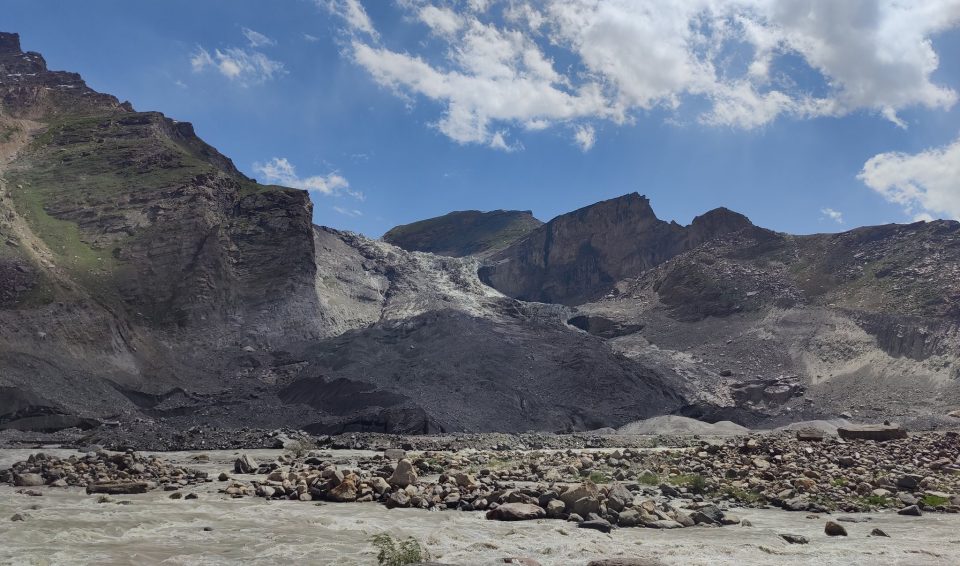
Rapidly melting Ladakh glacier may create 3 lakes, cause floods: Study

The Parkachik Glacier in Ladakh, which has been melting six times quicker over the past 20 years than previously, may give birth to three glacial lakes, which may lead to floods in the Himalayas, scientists have found.
Parkachik Glacier is one of the largest glaciers in the Suru River valley, which is part of the Southern Zanskar Ranges in the western Himalaya. The Zanskar Range lies in the Union Territory of Ladakh.
The three lakes may have an average depth ranging between 34 and 84 metres, and they could be a potential source of floods resulting from glacial lake outburst, scientists from the Wadia Institute of Himalayan Geology, Dehradun, have said.
Also read: Invisible glacier loss in greater Himalayas greatly underestimated: Study
The glacier’s yearly melting rate was six times faster between 1999 and 2021 (22 years) than that calculated from 1971 to 1999 (28 years), the scientists found using satellite data to determine its glacial retreat from 1971 to 2021. The findings have been published in the journal titled Annals of Glaciology.
Three new lakes may form in Parkachik Glacier in Ladakh due to glacial retreat
Scientists from Wadia Institute of Himalayan Geology, an autonomous institute under the Department of Science & Technology carried out a study that describes the morphological and dynamic changes of… pic.twitter.com/bnrbgK8wi8
— PIB India (@PIB_India) July 28, 2023
About glacial lakes
The study attributed the accelerated glacial retreat to ongoing climate warming, which also causes surface morphological or geological changes to glaciers.
Faster glacial retreat, along with surface morphological changes, has been known to result in the formation of new glacial lakes and expansion of existing ones, a potential source of glacial-lake-outburst floods. Glacial lakes are formed when a glacier erodes the land and then melts, filling the depression created by it.
In this study, the scientists have identified three potential overdeepening sites for lake formation on the glacier at different elevations. The area of each of these lakes could range from 43 to 270 hectares.
Also read: Himalayas to lose 75 per cent of snow by 2100 leading to eco disaster
They said, however, that the expansion and reduction of these lakes depend on the dynamics of the glacier.
The study’s surface-ice velocity estimation suggested a slowing down, resulting in an increase of debris cover on the glacier surface, or the ablation zone, it said.
(With agency inputs)
